MariaDB End of Life (EOL) Dates and End of Support (EOS) Dates
MariaDB end of life (EOL) and end of support (EOS) dates: 25 MariaDB versions have reached EOL, including MariaDB 12.2 (EOL date: May 28, 2026) — no longer receiving security updates or patches. MariaDB 13.0 reaches its End of Support date on Dec 31, 2026 — plan your upgrade path now. MariaDB 12.3.4 LTS is the current supported release, with support through Jun 12, 2029 — 4 versions in active support. Also see ArangoDB end of support life for related end-of-life information.
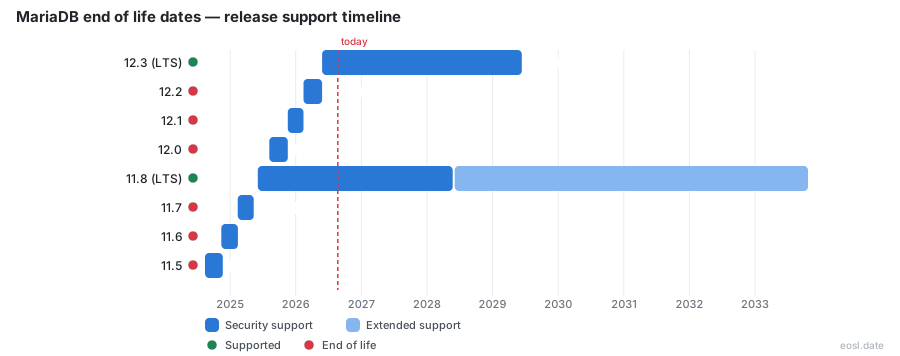
Currently Supported MariaDB Releases - Active EOS/EOSL Support (4)
| Release | Released | Community support | Enterprise support | Latest | LTS |
|---|---|---|---|---|---|
| 12.3 (LTS) | (5 months ago) | (in 2 years and 6 months) | (in 7 years and 11 months) | 12.3.4 (1 week and 1 day ago) | LTS |
| 11.8 (LTS) | (1 year and 5 months ago) | (in 1 year and 6 months) | (in 6 years and 11 months) | 11.8.10 (1 week and 1 day ago) | LTS |
| 11.4 (LTS) | (2 years and 5 months ago) | (in 2 years and 6 months) | (in 6 years and 1 month) | 11.4.14 (1 week and 1 day ago) | LTS |
| 10.11 (LTS) | (3 years and 9 months ago) | (in 1 year and 2 months) | (in 1 year and 2 months) | 10.11.20 (1 week and 1 day ago) | LTS |
MariaDB Releases Nearing End of Life - Support Ending Soon (1)
| Release | Released | Community support | Enterprise support | Latest | LTS |
|---|---|---|---|---|---|
| 13.0 | (2 months ago) | (in 1 month and 1 week) | Active | 13.0.2 (2 months ago) | - |
MariaDB End of Life (EOL) Releases - No Longer Supported (25)
| Release | Released | Community support | Enterprise support | Latest | LTS |
|---|---|---|---|---|---|
| 12.2 | (9 months ago) | (5 months ago) | Active | 12.2.2 (9 months ago) | - |
| 12.1 | (1 year ago) | (9 months ago) | Active | 12.1.2 (1 year ago) | - |
| 12.0 | (1 year and 3 months ago) | (1 year ago) | Active | 12.0.2 (1 year and 3 months ago) | - |
| 11.7 | (1 year and 9 months ago) | (1 year and 6 months ago) | Active | 11.7.2 (1 year and 9 months ago) | - |
| 11.6 | (2 years ago) | (1 year and 9 months ago) | Active | 11.6.2 (2 years ago) | - |
| 11.5 | (2 years and 3 months ago) | (2 years ago) | Active | 11.5.2 (2 years and 3 months ago) | - |
| 11.3 | (2 years and 9 months ago) | (2 years and 5 months ago) | Active | 11.3.2 (2 years and 9 months ago) | - |
| 11.2 | (3 years ago) | (2 years ago) | Active | 11.2.6 (2 years ago) | - |
| 11.1 | (3 years and 3 months ago) | (2 years and 3 months ago) | Active | 11.1.6 (2 years and 3 months ago) | - |
| 11.0 | (3 years and 5 months ago) | (2 years and 5 months ago) | Active | 11.0.6 (2 years and 6 months ago) | - |
| 10.10 | (4 years ago) | (3 years ago) | Active | 10.10.7 (3 years ago) | - |
| 10.9 | (4 years and 3 months ago) | (3 years and 2 months ago) | Active | 10.9.8 (3 years and 3 months ago) | - |
| 10.8 | (4 years and 6 months ago) | (3 years and 6 months ago) | Active | 10.8.8 (3 years and 6 months ago) | - |
| 10.7 | (4 years and 9 months ago) | (3 years and 9 months ago) | Active | 10.7.8 (3 years and 9 months ago) | - |
| 10.6 (LTS) | (5 years and 4 months ago) | (4 months ago) | (in 2 years and 9 months) | 10.6.28 (3 months ago) | LTS |
| 10.5 (LTS) | (6 years and 4 months ago) | (1 year and 4 months ago) | (1 year and 4 months ago) | 10.5.29 (1 year and 6 months ago) | LTS |
| 10.4 (LTS) | (7 years and 5 months ago) | (2 years and 5 months ago) | (2 years and 5 months ago) | 10.4.34 (2 years and 6 months ago) | LTS |
| 10.3 | (8 years and 5 months ago) | (3 years and 5 months ago) | (3 years and 5 months ago) | 10.3.39 (3 years and 6 months ago) | - |
| 10.2 | (9 years and 5 months ago) | (4 years and 5 months ago) | (4 years and 5 months ago) | 10.2.44 (4 years and 6 months ago) | - |
| 10.1 | (11 years and 1 month ago) | (6 years and 1 month ago) | (6 years and 1 month ago) | 10.1.48 (6 years ago) | - |
| 10.0 | (12 years and 7 months ago) | (7 years and 7 months ago) | (7 years and 7 months ago) | 10.0.38 (7 years and 9 months ago) | - |
| 5.5 (LTS) | (14 years and 7 months ago) | (6 years and 7 months ago) | (6 years and 7 months ago) | 5.5.68 (6 years and 6 months ago) | LTS |
| 5.3 | (14 years and 8 months ago) | (9 years and 8 months ago) | (9 years and 8 months ago) | 5.3.12 (13 years and 9 months ago) | - |
| 5.2 | (16 years ago) | (11 years ago) | (11 years ago) | 5.2.14 (13 years and 9 months ago) | - |
| 5.1 | (16 years and 9 months ago) | (11 years and 9 months ago) | (11 years and 9 months ago) | 5.1.67 (13 years and 9 months ago) | - |
Running a MariaDB end of life check on your fleet starts with one fact: every release series stops receiving security patches and bug fixes on a published date, and community support for the 10.6 series ended on 6 July 2026. This open source database server, built by the original developers of MySQL, follows a predictable release model, so you can plan every production upgrade months ahead. Below you get the full date table, what each support tier covers, and three practical ways forward.
MariaDB End of Life Dates for Every Release Series
The table below lists the series that still matter today, using the dates published by the project and tracked by lifecycle sites as of October 2026. A series is GA (generally available) on its first stable release, and its Community Server builds are maintained until the date in the third column. Enterprise Server builds from the vendor can run longer, as the fourth column shows.
| Series | GA date | Community end of maintenance | Enterprise end of support |
|---|---|---|---|
| 12.3 (LTS) | 28 May 2026 | 12 Jun 2029 | Not yet listed |
| 11.8 (LTS) | 4 Jun 2025 | 4 Jun 2028 | 22 Oct 2033 |
| 11.4 (LTS) | 29 May 2024 | 29 May 2029 | 16 Jan 2033 |
| 10.11 (LTS) | 16 Feb 2023 | 16 Feb 2028 | 16 Feb 2028 |
| 10.6 (LTS) | 6 Jul 2021 | Ended 6 Jul 2026 | 23 Aug 2029 |
| 10.5 (LTS) | 24 Jun 2020 | Ended 24 Jun 2025 | Ended 16 Jul 2025 |
It also helps to know what you are actually running. MariaDB Server began as an open source fork of MySQL, and the Community Server download is the free build most teams install. The MariaDB Community Server follows the dates above, while the paid Enterprise Server build shares its code but adds longer patching. A MySQL shop moving over finds the database familiar, and most MySQL tooling still works against it. Check your database version with SELECT VERSION() before you read the table, because the package name on many Linux distributions hides the real server release. The Community and Enterprise builds follow different end dates, so confirm which one you run before you trust a date.
Short-term series such as 12.2, 12.1 and 11.7 have already ended, and the newest rolling series, 13.0, receives community maintenance only until 31 December 2026. If you run anything on that rolling line, treat it as a stepping stone, not a destination.
Long Term Support Series Compared
Five long term support series sit in the community lifecycle today: MariaDB 10.11, MariaDB 11.4, MariaDB 11.8, MariaDB 12.3 and the one that just ended. Each LTS series is the one to pick for stable production work because it gets fixes for years instead of months. The older 11.4 line has a longer window than the newer yearly LTS model, which gives 11.8 and 12.3 three years of community binaries. That is why 11.8 ends before 11.4 even though it is newer.
Community Support Versus Enterprise Support
Community support means the project led by the MariaDB Foundation ships maintenance releases and answers on public channels. Enterprise support adds professional support from engineers who work on the code, plus a longer window, which is why the 10.6 enterprise date runs to 2029. This extended support matters most when your enterprise change process cannot absorb a major jump this year.
Amazon RDS Version Currency for MariaDB
If you use Amazon RDS, a second calendar applies. Amazon publishes its own cloud-hosted version currency timeline for the managed database service, listing the community release date, the RDS release date and the end of standard support. RDS offers each major version from 10.6 through 11.8 and carries current minor version builds such as 11.8.9, 11.4.13 and 10.11.19, while 12.3 started in a preview environment. Older lines such as 10.5 sit under deprecated versions. A migration to a newer major version on RDS follows the same checklist as a self-managed one, but you still need to reach the new version before the service retires the old one.
What the EOL Date Means for Your MariaDB Servers
When a series reaches end of life, the maintainers stop shipping security fixes and corrections for it. Your database does not stop working the next morning, and your data stays readable. The danger is slow: every new vulnerabilities report after the cutoff stays unpatched, so the risk compounds with each month. Security teams, auditors and cyber insurers treat an unpatched production system as a finding.
The key takeaways for planning are simple:
- The EOL date is the last day of community maintenance, not the day your server fails.
- A missed date raises compliance and regulatory exposure, especially in finance, health care and government work.
- Staying put on an expired series needs either paid vendor patches or a clear plan to leave.
- Planning a move early keeps downtime to a short, scheduled window instead of an emergency.
Vendor posts often close with a Frequently Asked Questions block; for 10.6 the answer to nearly all of them is to move before the 6 July 2026 cutoff, not after it.
Why MariaDB 10.6 Reached the End of Its Support Lifecycle
MariaDB 10.6 was the last LTS released under the previous release model, and it served distributions, applications and production environments for five years. The MariaDB Foundation announced that after 6 July 2026 there would be no more fixes of any kind, plus one last binary in late July. The reasoning in the announcement is about focus: with the new 12.3 LTS out, the project would otherwise carry five LTS series at once, which is one more than it can maintain well.
Maintaining an LTS series is real work. It covers bug fixing, security reviews, packaging, testing, documentation updates and coordination across many contributors. Dropping the oldest series lets that effort go to the newer ones. The source code stays available, and corrective releases simply stop, so you should install the last 10.6 build (10.6.28 at the time of writing) if you must stay for now.
Keep this in context: 10.6 is not unusual. Each stable series follows the same path from GA to retirement, and the MariaDB 10.5, 10.4 and 10.3 lines already walked it.
MariaDB Release Cadence and Maintenance Period Rules
The project publishes a regular release cadence: a new GA version every few months, with a yearly LTS pick. A maintenance period starts at GA and runs for a fixed span, after which the series is retired. Because the pattern repeats, you can read the table above as a template and estimate when the next series will leave support. Each version ships with release notes and changelogs that spell out what changed, so read them before any update. Because the cadence is fixed, every server series gets a predictable end date, and your maintenance window should be scheduled against it.
Rolling Releases and the Yearly Cycle
Rolling releases are short-lived: a series gets a few months of bug fixes and is replaced by the next one. They suit teams that test continuously. The LTS series suits teams that want a calm platform, and the foundation targets one new LTS per year, so you can budget a yearly look at your upgrade path. A rolling series is also the first to expire: 13.0 community maintenance ends on 31 December 2026, only months after its release.
MariaDB Foundation Maintenance Policy
The policy page sets the long-term and rolling end dates that the table above reports. The MariaDB Foundation is a non-profit that keeps the relational database behind MariaDB Server open, with GPL licensing independent of any company. Its maintenance policy page lists long-term and rolling release periods, and it works with the commercial vendor, MariaDB plc, which sells the supported product. The foundation also funds work on storage engines, plugins and packaging, and it keeps the drop-in replacement promise for MySQL users, so SQL clients written for one usually run on the other. Wider community contributions, supported by sponsors, keep the project going, and the foundation exists to guarantee continuity of that community effort. The same SQL dialect and tooling carry across versions, which makes planned moves routine.
Extended Support Paths After Community Maintenance Ends
Once your series is out of community support you have three realistic options. Before choosing, write an upgrade plan that includes a staging environment test, verified backups, a rollback procedure, a maintenance window, a check of application compatibility and a list of configuration changes. Read the upgrade documentation for your target before you start.
Path One: Stay on 10.6 With Enterprise Server
Choose Enterprise Server if you need the same codebase with zero application changes. The vendor keeps patching the 10.6 server until August 2029, adds auditing and hardened plugins, and publishes a STIG, which helps government and defence buyers. It suits mission-critical systems under strict change control. The trade-off is cost and the fact you are still postponing the move to a newer line.
Path Two: Upgrade to a Newer Server Version
The self-managed route is an upgrade to 10.11, 11.4, 11.8 or 12.3. Most teams pick 11.8 (to June 2028) or 12.3 (to June 2029) for the longest runway. Review the release notes for removed options, rehearse the move in staging, and keep a tested rollback. This path costs engineering time but avoids ongoing licence fees, and it keeps you on the community build, which stays open source under the same licence.
Path Three: Move to MariaDB Cloud as a Managed Database
MariaDB Cloud is the vendor's managed database offer. It removes patching and backup chores through automated features, and its support window reaches as far as 2033. A cloud move needs a data migration and a review of network and cost, so test it with a copy first, and finish before 10.6 loses its last vendor coverage. Pick it if you would rather run no servers at all.
Running in the cloud changes who owns each task. In a cloud deployment the provider handles patching, while you keep schema design and query tuning. Before a cloud cutover, compare cloud pricing with the cost of your own hardware, and confirm the cloud region meets your data residency rules. Like every other path, it keeps the open source engine you already know and the open source licensing behind it.
Whichever path you pick, decide now: dates in this table will not move, and the cheapest upgrade is the one you schedule before the series expires.