Mandrel End of Life (EOL) Dates and End of Support (EOS) Dates
Mandrel end of life (EOL) and end of support (EOS) dates: 15 Mandrel versions have reached EOL, including Mandrel 24.2 (JDK 24) (EOL date: Oct 21, 2025) — no longer receiving security updates or patches. Mandrel 25.0.5.0 LTS is the current supported release — 2 versions in active support. Also see GraalVM Community Edition end of support dates for related end-of-life information.
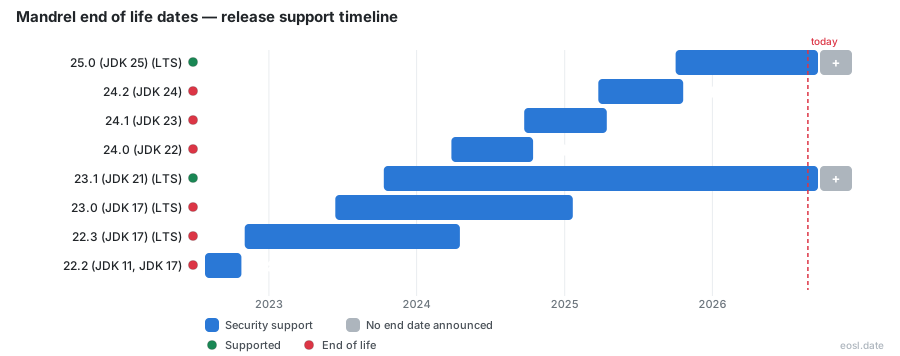
Currently Supported Mandrel Releases - Active EOS/EOSL Support (2)
Mandrel End of Life (EOL) Releases - No Longer Supported (15)
| Release | Released | Maintenance | Latest | LTS |
|---|---|---|---|---|
| 24.2 (JDK 24) | (1 year and 7 months ago) | (1 year and 1 month ago) | 24.2.2.0 (1 year and 3 months ago) | - |
| 24.1 (JDK 23) | (2 years and 1 month ago) | (1 year and 7 months ago) | 24.1.2.0 (1 year and 9 months ago) | - |
| 24.0 (JDK 22) | (2 years and 7 months ago) | (2 years and 1 month ago) | 24.0.2.0 (2 years and 4 months ago) | - |
| 23.0 (JDK 17) (LTS) | (3 years and 5 months ago) | (1 year and 10 months ago) | 23.0.6.0 (2 years and 1 month ago) | LTS |
| 22.3 (JDK 17) (LTS) | (4 years ago) | (2 years and 7 months ago) | 22.3.5.0 (2 years and 9 months ago) | LTS |
| 22.2 (JDK 11, JDK 17) | (4 years and 3 months ago) | (4 years ago) | 22.2.0.0 (4 years and 3 months ago) | - |
| 22.1 (JDK 11, JDK 17) | (4 years and 6 months ago) | (4 years and 3 months ago) | 22.1.0.0 (4 years and 6 months ago) | - |
| 22.1 (JDK 11, JDK 17) | (4 years and 9 months ago) | (4 years and 6 months ago) | 22.0.0.2 (4 years and 9 months ago) | - |
| 21.3 (JDK 11, JDK 17) (LTS) | (5 years and 1 month ago) | (3 years and 4 months ago) | 21.3.6.0 (3 years and 7 months ago) | LTS |
| 21.2 (JDK 11) (LTS) | (5 years and 4 months ago) | (4 years and 10 months ago) | 21.2.0.2 (5 years and 1 month ago) | LTS |
| 21.1 (JDK 11) | (5 years and 6 months ago) | (5 years and 4 months ago) | 21.1.0.0 (5 years and 6 months ago) | - |
| 21.0 (JDK 11) | (5 years and 9 months ago) | (5 years and 6 months ago) | 21.0.0.0 (5 years and 9 months ago) | - |
| 20.3 (JDK 11) (LTS) | (5 years and 10 months ago) | (5 years and 1 month ago) | 20.3.3.0 (5 years and 4 months ago) | LTS |
| 20.2 (JDK 11) | (6 years ago) | (5 years and 10 months ago) | 20.2.0.0 (6 years ago) | - |
| 20.1 (JDK 11) | (6 years and 3 months ago) | (5 years and 7 months ago) | 20.1.0.4 (5 years and 10 months ago) | - |
Mandrel end of life is decided release by release, so this page shows which builds still get fixes and which have already ended. Mandrel is the GraalVM-based toolchain that Quarkus relies on for native-image builds of Java applications, and Oracle's recent GraalVM announcement affects anyone who depends on it.
What the Mandrel Distribution Is and Why Its Lifecycle Matters
Mandrel is a downstream distribution of the GraalVM Community Edition, maintained by Red Hat. Its goal is narrow: package GraalVM's native image builder on top of a regular OpenJDK, aligned with the OpenJDK and Red Hat libraries that Quarkus users already run. Because it tracks the upstream code base with few changes, each release line inherits the lifecycle of the JDK it is built on. Software teams and enterprise developers therefore need to know the lifecycle before betting a production build on one version.
How Mandrel Differs From the Full GraalVM Build
A complete GraalVM bundles polyglot support, the Truffle framework, an LLVM back end, and the libgraal JIT compiler. Mandrel keeps only the Substrate VM, the SDK and the compiler needed for native-image on a stock OpenJDK. It skips the musl libc option, static images and the experimental build server, and it targets the container and cloud-native runtime on Linux and Arm. The smaller scope helps performance tuning, startup time and footprint, and it shrinks the code that must be maintained. That narrow scope is also why Mandrel's support window follows the JDK it is built on rather than GraalVM's own schedule.
Mandrel End of Life Dates by Release
The table lists the most relevant release lines, with the latest patch for each and whether it still receives maintenance. Each LTS line follows a JDK, and the release numbers moved to match the JDK numbering with 25.0.
| Release | JDK | Released | Maintenance ended | Latest |
|---|---|---|---|---|
| 25.0 (LTS) | JDK 25 | 02 Oct 2025 | Still maintained | 25.0.4.1 |
| 24.2 | JDK 24 | 25 Mar 2025 | 21 Oct 2025 | 24.2.2.0 |
| 24.1 | JDK 23 | 23 Sep 2024 | 15 Apr 2025 | 24.1.2.0 |
| 23.1 (LTS) | JDK 21 | 12 Oct 2023 | Still maintained | 23.1.12.1 |
| 23.0 (LTS) | JDK 17 | 14 Jun 2023 | 21 Jan 2025 | 23.0.6.0 |
| 21.3 (LTS) | JDK 11, JDK 17 | 20 Oct 2021 | 17 Jul 2023 | 21.3.6.0 |
Maintenance Window and Release Cadence
Mandrel follows the GraalVM community release cadence in principle but stretches the maintenance window for long-term JDK versions. Since JDK 20, it tracks the six-month JDK schedule and supports the latest JDK plus at least the latest LTS. Sometimes it supports the two newest LTS lines to ease a transition. Anything marked ended in the table gets no more support, and legacy lines such as 21.3 are only reference points now.
Mandrel Versions Quarkus Still Supports
Starting with Quarkus 3.36, the minimum officially supported version for native executables rose from 23.1 to 25.0. That does not touch JVM mode, which still runs on JDK 17 through 25, and the minimum JDK is planned to reach 21 in Quarkus 4. If you build native Quarkus applications with Mandrel 23.1 for JDK 21, plan to upgrade, even though the 23.1 line, built on OpenJDK 21, is still shown as maintained for Java teams.
Why Quarkus Raised Its Minimum GraalVM Version
The Quarkus team wanted less maintenance overhead and a tighter focus on mature releases. GraalVM and Mandrel 25.0 became the default in January 2026 and ship with the current Quarkus LTS, so customers get the best-tested security fixes there.
Mandrel Releases After Oracle's GraalVM Changes
In September 2025, Oracle announced that GraalVM for JDK 24 was the final release licensed and supported as part of its Java SE products, and the early-adopter Native Image technology is being discontinued for those customers. Legacy builds remain available through Oracle Support, and users are told to move to Oracle JDK or the default C2 JIT instead of the Graal JIT. The company points to Project Leyden and ahead-of-time features in OpenJDK as the roadmap. Oracle's patches and updates for those paths do not cover the community Mandrel line, so check the GraalVM release calendar before you plan.
Where Red Hat Fits Into the Mandrel Lifecycle
Red Hat leads the upstream OpenJDK update streams that Mandrel builds on, and it lets the community distribution keep following that code. The Red Hat build of Quarkus ships a productized Mandrel image, so enterprise users can rely on it instead of Oracle. Its support terms come from Red Hat's product policy, which can differ from the community maintenance dates in the table above.
Planning Your Upgrade Path Before the Mandrel Lifecycle Ends
Pick a supported line, rebuild your Java native-image output on the OpenJDK your pipeline already uses, and compare behavior. Downloads and container images for each version are published by the community, and Red Hat Enterprise Linux and Fedora users can add the required packages with their package manager. Test your migrate step in CI before changing production.
Native-Image Build Prerequisites on Linux
Before moving to a supported line, check that your build environment has the packages the newer toolchain expects: install GCC, glibc and zlib development headers, freetype and the static C++ library. On Ubuntu-like systems, apt install g++ zlib1g-dev libfreetype6-dev covers the essentials.
Building Mandrel From Source
Mandrel is built with mx, a Python build tool, driven by the mandrel-packaging project. It builds the Java parts first, then the native parts, and assembles them with an upstream OpenJDK. Teams stuck on an ended line can use it for a custom build, but they then get no upstream fixes for that version.