Istio End of Life (EOL) Dates and End of Support (EOS) Dates
Istio end of life (EOL) and end of support (EOS) dates: 23 Istio versions have reached EOL, including Istio 1.29 (EOL date: Oct 15, 2026) — no longer receiving security updates or patches. Istio 1.30 reaches its End of Support date on Dec 16, 2026 — plan your upgrade path now. Also see Calico end of support dates for related end-of-life information.
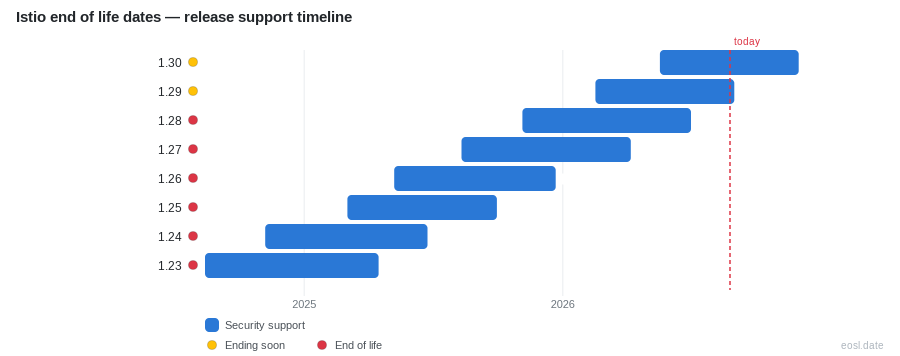
Istio Releases Nearing End of Life - Support Ending Soon (2)
Istio End of Life (EOL) Releases - No Longer Supported (23)
| Release | Supported Kubernetes Versions | Released | Security Support | Latest |
|---|---|---|---|---|
| 1.29 | 1.31 - 1.35 | (9 months ago) | (1 month and 2 days ago) | 1.29.10 (3 weeks and 5 days ago) |
| 1.28 | 1.30 - 1.34 | (1 year ago) | (4 months ago) | 1.28.10 (4 months ago) |
| 1.27 | 1.29 - 1.33 | (1 year and 3 months ago) | (7 months ago) | 1.27.9 (7 months ago) |
| 1.26 | 1.29 - 1.33 | (1 year and 6 months ago) | (10 months ago) | 1.26.8 (10 months ago) |
| 1.25 | 1.29 - 1.32 | (1 year and 8 months ago) | (1 year and 1 month ago) | 1.25.5 (1 year and 2 months ago) |
| 1.24 | 1.28 - 1.31 | (2 years ago) | (1 year and 4 months ago) | 1.24.6 (1 year and 6 months ago) |
| 1.23 | 1.27 - 1.30 | (2 years and 3 months ago) | (1 year and 7 months ago) | 1.23.6 (1 year and 7 months ago) |
| 1.22 | 1.27 - 1.30 | (2 years and 6 months ago) | (1 year and 9 months ago) | 1.22.8 (1 year and 9 months ago) |
| 1.21 | 1.26 - 1.29 | (2 years and 8 months ago) | (2 years and 1 month ago) | 1.21.6 (2 years and 1 month ago) |
| 1.20 | 1.25 - 1.29 | (3 years ago) | (2 years and 4 months ago) | 1.20.8 (2 years and 4 months ago) |
| 1.19 | 1.25 - 1.28 | (3 years and 2 months ago) | (2 years and 6 months ago) | 1.19.10 (2 years and 6 months ago) |
| 1.18 | 1.24 - 1.27 | (3 years and 5 months ago) | (2 years and 10 months ago) | 1.18.7 (2 years and 10 months ago) |
| 1.17 | 1.23 - 1.26 | (3 years and 9 months ago) | (3 years ago) | 1.17.8 (3 years and 1 month ago) |
| 1.16 | 1.22 - 1.25 | (4 years ago) | (3 years and 3 months ago) | 1.16.7 (3 years and 3 months ago) |
| 1.15 | 1.22 - 1.25 | (4 years and 2 months ago) | (3 years and 7 months ago) | 1.15.7 (3 years and 7 months ago) |
| 1.14 | 1.21 - 1.24 | (4 years and 5 months ago) | (3 years and 10 months ago) | 1.14.6 (3 years and 11 months ago) |
| 1.13 | 1.20 - 1.23 | (4 years and 9 months ago) | (4 years and 1 month ago) | 1.13.9 (4 years and 1 month ago) |
| 1.12 | 1.19 - 1.22 | (4 years and 11 months ago) | (4 years and 4 months ago) | 1.12.9 (4 years and 4 months ago) |
| 1.11 | 1.18 - 1.22 | (5 years and 3 months ago) | (4 years and 7 months ago) | 1.11.8 (4 years and 8 months ago) |
| 1.10 | 1.18 - 1.21 | (5 years and 5 months ago) | (4 years and 10 months ago) | 1.10.6 (4 years and 11 months ago) |
| 1.9 | 1.17 - 1.20 | (5 years and 9 months ago) | (5 years and 1 month ago) | 1.9.9 (5 years and 1 month ago) |
| 1.8 | 1.16 - 1.19 | (5 years and 11 months ago) | (5 years and 6 months ago) | 1.8.6 (5 years and 6 months ago) |
| 1.7 | 1.16 - 1.18 | (6 years and 2 months ago) | (5 years and 8 months ago) | 1.7.8 (5 years and 8 months ago) |
Your Istio end of life date decides how long your service mesh keeps receiving security fixes. Istio adds traffic management, telemetry and security to Kubernetes, but only the currently supported builds get patches, so a build that slips out of the window stops hearing about new vulnerabilities. Check the table below against what you run, then plan your move before support for Istio ends on your release's date.
Istio end of life dates: release date and support status
Every release carries a launch date, a standing and an end of life date. The project publishes the support status of each release on its supported releases page, and the table below summarizes it. A provisional date becomes final only when the end of life announcement goes out; until then, treat it as a planning estimate rather than a promise.
| Release | Launched | Support ends | Standing |
|---|---|---|---|
| 1.31 | Aug 2026 | ~Feb 2027 (expected) | Supported, latest |
| 1.30 | May 2026 | ~Dec 2026 (expected) | Supported |
| 1.29 | Feb 2026 | Oct 2026 | Support for Istio 1.29 has ended |
| 1.28 | Nov 2025 | Jul 2026 | Support for Istio 1.28 has ended |
| 1.27 | Aug 2025 | Apr 2026 | Support for Istio 1.27 has ended |
Check your cluster against the table before you choose a target, because a release whose support has ended cannot be fixed in place.
How to check which Istio build you run
Run istioctl version to print the client and mesh builds. If it reports a release that has ended, treat it as unsupported, compare it with the table, and start moving.
Istio support policy and the support window
The support policy is simple: the project builds Istio from every commit, cuts a new release about once a quarter, and ships a patch release for each issue found afterward. Support means the project will publish a patch release for critical issues and offer technical assistance. Partners may sell longer-term support, but the project does not.
The support window follows an N+2 rule: a release stays supported until 6 weeks after the N+2 release arrives, which is why the end date stays provisional until then.
$$\text{support end}_{N} = \text{release date}_{N+2} + 42\ \text{days}$$
Test it on a real case. Release 1.31.0 shipped on 31 August 2026, and 42 days later is 12 October 2026, the day support for Istio 1.29 ended. If 1.32.0 shipped on 9 November 2026, support for 1.30 would end on 21 December 2026, in step with the estimate in the table. Support for Istio ends on that schedule whether or not you have upgraded.
Minor release and patch release support
A minor stream gets the full window, and support for Istio on it continues until the N+2 rule closes it. Every patch release shares the support level of its release, and a security-focused patch is a patch release that also carries a security fix. Patch releases bring bug fixes only and no backward incompatible changes, following semantic versioning, so adopt each patch release the day it ships. Every patch release of a release shares that release's end date. The next minor version restarts that cycle.
Support announcements and when support for Istio ends
The project posts support announcements in pairs. An end of life announcement arrives weeks ahead, for example "Support for Istio 1.29 ends on the 12th of October, 2026", and a closing note follows when support for Istio on that release ends. The closing note reads "Support for Istio 1.29 has ended", and no further patch release follows. Subscribe to the news feed so each end of life announcement reaches you the day it lands.
| Support announcements | Posted | Type |
|---|---|---|
| Support for Istio 1.29 has ended | Oct 16, 2026 | End of life announcement |
| Support for Istio 1.29 ends on the 12th of October, 2026 | Sep 9, 2026 | Upcoming end of life announcement |
| Support for Istio 1.28 has ended | Jul 1, 2026 | End of life announcement |
| Support for Istio 1.28 ends on the 28th of June, 2026 | May 29, 2026 | Upcoming end of life announcement |
| Support for Istio 1.27 has ended | Apr 7, 2026 | End of life announcement |
Watch support announcements and security bulletins together. Support announcements tell you when a release closes, and security bulletins tell you what that closure exposes. Read the support announcements each month, then the security bulletins each time a patch release lands; the support announcements archive on the news page lists every closed release back to Istio 1.0, and the security bulletins archive does the same for each CVE. Support announcements are brief, while security bulletins carry the CVSS detail.
Security bulletins and CVEs for ended releases
The security bulletins list each CVE, its CVSS score and the affected versions. Security fixes go only to currently supported branches, so a CVE disclosed after your release ended will never be patched there.
| Security bulletin | CVE | CVSS | Affected versions |
|---|---|---|---|
| ISTIO-SECURITY-2026-007 | CVE-2026-111497, an AuthorizationPolicy bypass and an istiod denial of service in ambient mode | 9.2 | 1.31.0 to 1.31.1, 1.30.0 to 1.30.5, 1.29.0 to 1.29.8 |
| ISTIO-SECURITY-2026-006 | CVE-2026-73513 and other Envoy CVE entries | 7.7 | 1.29.0 to 1.29.6, 1.30.0 to 1.30.3 |
| ISTIO-SECURITY-2026-005 | CVE-2026-47692 and other Envoy CVE entries | 7.5 | 1.30.1 to 1.30.2, 1.29.4 to 1.29.5, 1.28.8 to 1.28.9 |
The ztunnel component and istiod both appear in recent security bulletins, so a single vulnerability can reach either one. Read each security CVE for its CVSS score and affected versions. A bulletin that lists your release as affected after its support has closed has no fixed patch release for you, so the only remedy is to move to a supported release; each security bulletin names the fixed patch release to compare with your build.
Supported releases without known CVEs
Being on a supported release is not enough; you also need a patched build. The project tracks the lowest patch release with no known CVEs for each release: 1.31.3 or later, 1.30.7 or later, and 1.29.10 or later. Older patch releases of a release stay exposed even while the release is maintained.
Supported Kubernetes versions and the release branch
Each row of the project's table lists the supported versions and a wider group that was only tested. Stay inside the first group. Every release also maps to one Envoy release branch, so an Istio upgrade moves the proxy too.
Release announcements across Istio releases
The release announcements on the news page cover every Istio release, with release notes and change notes for each one. A patch release announcement is short, while a new release ships long upgrade notes and change notes. The GitHub releases page mirrors each one, including every alpha, beta and pre-release. Read the upgrade notes and the release notes of a new release before you plan a rollout. A development build has no support at all.
The patch release cadence is steady. Between mid-September and late October 2026, the project shipped nine patch release builds across three supported branches, and every patch release came with release notes and a short entry in the release announcements. A patch release often bundles a security patch, so a patch release is worth applying even when the release notes look small.
| Release announcements | Patch release | Date |
|---|---|---|
| Announcing Istio 1.31.3 | 1.31.3 patch release | Oct 21, 2026 |
| Announcing Istio 1.30.7 | 1.30.7 patch release | Oct 21, 2026 |
| Announcing Istio 1.29.10 | 1.29.10 patch release | Oct 21, 2026 |
| Announcing Istio 1.31.2 | 1.31.2 patch release | Oct 15, 2026 |
| Announcing Istio 1.30.6 | 1.30.6 patch release | Oct 15, 2026 |
| Announcing Istio 1.29.9 | 1.29.9 patch release | Oct 15, 2026 |
| Announcing Istio 1.31.1 | 1.31.1 patch release | Sep 21, 2026 |
| Announcing Istio 1.30.5 | 1.30.5 patch release | Sep 21, 2026 |
| Announcing Istio 1.29.8 | 1.29.8 patch release | Sep 21, 2026 |
- Patch release: bug fixes and a security patch; these announcements stop once the release has ended.
- Release announcements for a new release: describe new behavior, and the change notes list each difference.
- Release notes: list every change in the patch release or the new release, and the upgrade notes explain how to move.
Naming scheme and how a minor release ends on schedule
The naming scheme is major.minor.patch. The middle number rises with each release, and the last counts the patch release series for that release. Before a release reaches users it passes release qualification, and the traffic management, telemetry and security features of the mesh are checked together. Once the N+2 release lands, the clock starts and the older release ends on schedule six weeks later.
Control plane and data plane skew with Envoy
The mesh brain may run one release ahead of the proxies, never behind it. Revisions let you run two copies side by side and move workloads gradually, which removes skew altogether. Sidecar and gateway proxies are Envoy builds. Keep this in mind when you move off a release whose support has ended.
What to do once an Istio release has ended
When support for your release has ended, upgrade to a supported release straight away, because the maintenance window is closed and the community will not backport any fix. Read the upgrade notes, deploy the new release as a revision, move a test namespace first, then migrate the remaining deployments. Move one release at a time rather than skipping several. If you cannot upgrade at once, a partner offering longer-term support is the only way to keep receiving patches, and the calendar and RSS feed help you plan the next move.
Build a habit around each end of life announcement. When support for Istio ends on a release you use, the project stops publishing a patch release for it, so every later CVE becomes yours to close by moving up. Put the date each end of life announcement says support ends on into your calendar, read the CVSS score and affected versions in every security bulletin, and skim the change notes before each upgrade. A denial of service or a CVE scored near 9 in your affected versions is the signal to move now, not at the next maintenance cycle.
Treat each release like a clock. For every release you run, note when it launched, which release starts its countdown, and its last patch release. When that next release ships, add 42 days. Each patch release and each release announcement then shows whether your release still gets a patch release, a CVE fix or only change notes. Change notes show what a release changes; the CVE list shows what it fixes, while the CVSS and affected versions show how urgent that release is.