Elasticsearch End of Life (EOL) Dates and End of Support (EOS) Dates
Elasticsearch end of life (EOL) and end of support (EOS) dates: 9 Elasticsearch versions have reached EOL, including Elasticsearch 9.3 (EOL date: Aug 04, 2026) — no longer receiving security updates or patches. Elasticsearch 9.5.6 is the current supported release — 3 versions in active support. Also see ArangoDB end of support life for related end-of-life information.
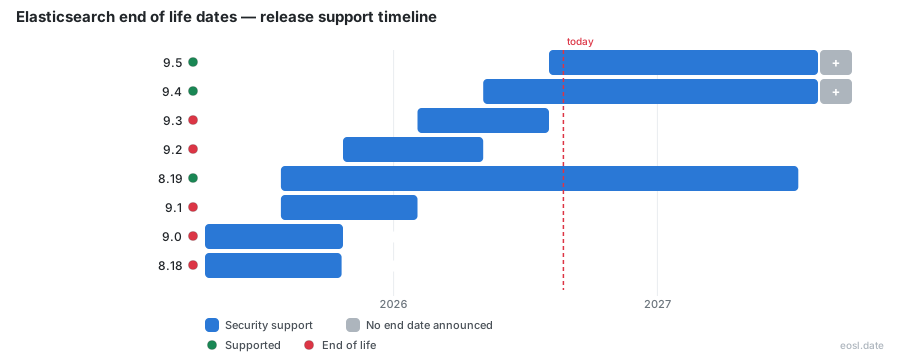
Currently Supported Elasticsearch Releases - Active EOS/EOSL Support (3)
Elasticsearch End of Life (EOL) Releases - No Longer Supported (9)
| Release | Released | Support | Latest |
|---|---|---|---|
| 9.3 | (9 months ago) | (3 months ago) | 9.3.8 (4 months ago) |
| 9.2 | (1 year ago) | (6 months ago) | 9.2.8 (7 months ago) |
| 9.1 | (1 year and 3 months ago) | (9 months ago) | 9.1.10 (10 months ago) |
| 9.0 | (1 year and 7 months ago) | (1 year ago) | 9.0.8 (1 year and 1 month ago) |
| 8.18 | (1 year and 7 months ago) | (1 year and 1 month ago) | 8.18.8 (1 year and 1 month ago) |
| 8.17 | (1 year and 11 months ago) | (1 year and 3 months ago) | 8.17.10 (1 year and 3 months ago) |
| 8.16 | (2 years ago) | (1 year and 7 months ago) | 8.16.6 (1 year and 7 months ago) |
| 7 | (7 years and 7 months ago) | (10 months ago) | 7.17.29 (1 year and 4 months ago) |
| 6 | (9 years ago) | (4 years and 9 months ago) | 6.8.23 (4 years and 10 months ago) |
Your Elasticsearch end of life date decides how long a cluster keeps receiving fixes. Elasticsearch is an open source, distributed database and search engine built on Lucene, offering full-text search over JSON documents through an HTTP web interface, so an unpatched node puts real data at risk. Use this guide to find your version's date and plan the next step.
Elasticsearch End of Life Dates by Release
Elastic runs one schedule for the whole Elastic Stack, the product family once called the ELK Stack. Kibana, Logstash, Beats, Elastic Agent and APM Server therefore follow the same dates as Elasticsearch, and Elasticsearch-Hadoop does too. Elastic Cloud Enterprise and Elastic Cloud on Kubernetes each keep their own series. The table lists the EOL dates for the release series, and every release date and version is recorded in the Elastic policy.
| Release series | Maintenance ends | Support ends |
|---|---|---|
| 9.x | 15 Oct 2027 or later | Six months later |
| 8.x | 15 Jan 2027 | 15 Jul 2027 |
| 7.17.x | 15 Apr 2025 | 15 Jan 2026 |
| 6.x | Ended 10 Feb 2022 | Ended |
Compare the release date of your own build against this table, because older versions drop out first. The APM agents (Java, Go, Node.js) and the platform and operating system rules sit in the support matrix. A public RSS feed and an iCalendar feed announce changes, and the full lifecycle is on the vendor page.
Latest Version and LTS: Which Versions Are Still in Maintenance Term
Elasticsearch 9.5 is the latest version, and 9.5.5 is the newest patch version. Two release lines have supported versions today: 9.x and 8.x, where 8.19 is the last minor of that line. The long-term support question has a short answer. Elastic has no LTS or long-term support line, so all versions follow the same period. Branches 7.x and 6.x are fully retired, with 6.8 as the last minor of the older line. Old versions such as 5.6 and 7.10 got no further fixes either, and unstable versions never count as supported.
Elastic Version Policy for End of Support
The Elastic version policy sets every date from two numbers. The support term runs through the end of maintenance term plus six months. A major release stays in maintenance for the longer of 30 months from general availability (GA) or 18 months after the next major release, and all versions in that series share the result.
\(\text{maintenance end} = \max(\text{GA} + 30\text{ months},\ \text{next GA} + 18\text{ months})\)
Take a made-up version 5.0 shipped on 1 March 2024 and 6.0 on 1 November 2025. Thirty months after 5.0 is 1 September 2026, while 18 months after 6.0 is 1 May 2027, so maintenance runs to 1 May 2027 and the end of support term lands on 1 November 2027. Elastic also gives 12 months of notice before it retires a product, and the supported platforms live in the support matrix.
Major Release and Minor Release Maintenance Term
Every series gets its maintenance term first. Within it, a maintenance release covers the most recent two minor releases of the current line, plus the final minor release of the previous major release. Elastic follows semantic versioning, so a major bump signals breaking changes.
Support Policy for Retired Software Products
When Elastic decides to retire a software product, it posts a retirement notice in its Retired Software Products table, and the product stays supported for at least 12 months.
End of Standard Support and Extended Support on OpenSearch Service
Amazon OpenSearch Service, the managed fork of Elasticsearch, runs its own clock. Standard Support brings regular bug fixes, while Extended Support delivers critical security fixes and operating system patches for a flat fee per normalized instance hour on top of the usual instance hour price. Domains on legacy 1.5, 2.3, 5.1 to 5.5 and 6.0 to 6.7 had standard support end on 7 November 2025, with the end of extended support on 7 November 2026, and version 5.6 getting until 2028. AWS expects customers to move to newer OpenSearch versions for better price-performance, and its Migration Assistant helps with that migration. Domains on versions 6.8 and 7.10 had no OpenSearch dates announced; the open source OpenSearch line moves under its own policy.
Security Risks of an Unsupported Elasticsearch Version
An unsupported release stops getting bug fixes and security fixes. Each new CVE and other security vulnerabilities in the Elastic License code stays open, and compliance audits notice. Expect patches to stop, dependencies to age, and performance, stability and resiliency gains to pass you by, as new features ship only to current clusters. Every unpatched node is a bigger target.
Upgrade Before an Elasticsearch Version Reaches EOL Dates
The upgrade path from 7.17 goes to 8.19 and then to a current 9 release, because that last 7.x minor is the supported stepping stone between versions. Read the breaking changes for each major step, test on a copy of your cluster, then roll the production nodes. If you cannot meet a deadline, OpenSearch is the other route.